2011年2月24日星期四

The Calculation of Energy

Energy Calculation
--the return of mole
CH4+2O2àCO2+2H2O
H for this exothermic reaction is expressed using the coefficients of the balanced equation:
-812KJ/1mol CH4 or -812KJ/2mol O2 = -406KJ/1mol O2

So the value of H depends on which chemical you are referring to
1.    The value of H changes with different reactions; -812KJ is only specific to this reaction. Thus like molar mass is different for each compound, H depends on the chemical reaction
2.    H is not a constant like Avogadros number

Ex. How many moles of CH4 are needed to produce 2100KJ of energy?

CH4+2O2àCO2+2H2O+812KJ
-2100KJ×-1mol CH4/812KJ =2.6mol

2011年2月21日星期一

TYPES OF REACTIONS (2)

Double Replacement
-A double replacement is a reaction between two IONIC compounds usually in solution. The ions switch partners like a dance. The (+) ions sitch places but remember to watch your charges.

General Formula
AB + CD→ CB+AD

Eg: CaCO3 + 2HCl → CaCl2 +  2H2

If a double replacement reaction actually occurs:
The reactants change state during reaction
(usually a precipitate occurring)


Use your "Table of solubilities" to determine the states.- (aq) or (s)


Net Ionic Equation:

-There is a net reaction when you have a precipitation that occurs
-(aq) ions that are the same on both sides get cancelled

Eg.
CaCl2 + Na2CO3 → CaCO3 + 2 NaCl

Net Ionic Equation 2Cl-  + 2Na+  → 2NaCl

Using the Table of Solubilities
1) Find your anion ( negative ion) in the left hand column.
2) Look for your cation (positive ion) in the list in the 2nd column.
3) Follow its presence or absence to the word "soluble" or "not soluble"
4) If soluble, the compound is (aq)
5) If insoluble, the compound is (s)


Combustion
-A combusion reaction is a reaction where burning in air is involved. The reactants are the chemical to be burned and the oxygen that it reats with. The oxygen atoms usually end up combined with more that one type of atom as products.

-General Formula
AB + O2 → AO + BO

Eg. CH4 + 2 O2 → 2 H2O + CO2


Neutralization
-A neutralization reaction is a sepcial double replacement reaction where acids reat with bases to produce water and an ionic salt as products.

-The acids have han H+ as the cation (+) and the bases have  OH- as the anion (-). Both should be aqueous solutions. (aq)

-General Formula
HA + BOH → H2O + BA

Eg. HCl + NaOH → NaCl + H2O


NOTE: For DR reaction (include Neutralization), some ions participate in the reaction wile other ions do not participate.

Eg. KCl(aq) + AgNO3(aq) → KNO3(aq) + AgCl(s)
* Be sure to write both the total and net ionic equations!!!
Total  ionic equation:  K+(aq)   + Cl- (aq) + Ag+(aq) + NO3-(aq → K+(aq)  + NO3-(aq) + AgCl(s)
Net Equation: Ag+(aq) + Cl-(aq)  → AgCl(s)


2011年2月17日星期四

Endothermic And Exothermic Reactions

Introduction
-All chemical reactions involves △Energy
Some release energy.  exothermic
Some absorb energy. endothermic


Molecules are held together by chemical bonds.
-Add energy to break bonds
-Give off energy to join together

Takes MORE enerygy to break down than it gives off to form bonds→Endothermic

Takes LESS energy to break down than it gives off to form bonds→ Exothermic

Enthalpy, H, heat contained in the system.

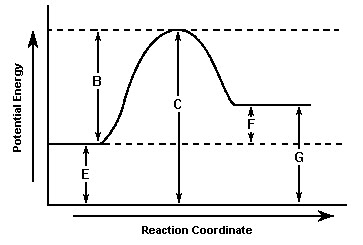
Energy Diagrams
-Chart the potential energy of the chemicals as they change from reactants to products
-Reactants start with a certain amount of energym energy is added to start the reactions and then energy is released as the reaction proceeds.
-The relative amounts of energy determine: Endothermic & Exothermic.

Energy of reactants: total E of all reactants in the reaction
Energy of products: total E of all products in the reaction
Energy of activated complex: potentioal E of the "transition state" between reactants & products
Activation Energy: The E must be added to get the reaction to progress.
△H: the change in potential energy during the reaction.
△H= E of reactants - E of products

Potential Energy Diagram


E of reactants < E of products                                               E of reactants  >E of products
△H is positive.                                                                        △H is negative.
Endothermic reaction                                                               Exothermic reaction.


The Energy absorption or release can be placed directly in the equation.

Eg. CH4+2O2CO2+2H2O+812KJ
      Higher E        Lower E


Exothermic reactions have the E term on the RIGHT side(RHS) -△H
Endothermic reactions have the E term on the Left side (LHS)    +△H


Eg.
E of Reactants= 150 KJ
E of Products= 100KJ
E of Activated complex= 300 KJ
△H=?      Ea=?

△H= E products- E reactants
      = 100KJ - 150KJ= -50KJ  ( exothermic)
Ea= E activated complex - E reactants
    = 300KJ - 150KJ= 150KJ

Eg.


E of Reactants (E)=200 KJ
△H(F)                =100 KJ ( Endothermic)
Ea(B)                        =300 KJ
E of activated complex (C) =?      E of Product (G)=?      

E of activated complex= Ea+ E of reactants= 200KJ+300KJ=500KJ
E of product= E of activated complex- E of reactants= 500 KJ- 200KJ= 300KJ


2011年2月9日星期三

Lab 5B

Objectives:
1.       To observe a variety of chemical reactions
2.       To interpret and explain observations with balanced chemical equations
3.       To classify each reaction as one of the four main types

Material and Equipment:
Refer to page 33 in Health Lab Text, Lab 5B

Procedure:
  Refer to page 33 in Health Lab Text, Lab 5B

Data and Observation:
  Attached to the back.

Analysis of results:
1.       Copper reacts with oxygen in the air.
2.       The solution become lighter blue indicates the concentration of CuSO4 in the solution decreased.
3.       The colour changes in reaction 3&4, which means new substance was yielded.
4.       The precipitate was CaCO3.
5.       Put a glowing (not burning) splint into the mouth of the test tube, the splint will start a flame. That shows the identity of supporting combustion.
6.       A. has the identity of supporting combustion.
B. Water.

Follow-up questions
1.       CdSO4+ZnàZnSO4+Cd
2.       2H2Oà2H2+O2 (decomposition)

Conclusion
1.       2Cu+O2à2CuO (synthesis)
2.       2Fe+3CuSO4àFe2(SO4)3+3Cu (single replacement)
3.       CuSO4·5H2OàCuSO4+5H2O  (decomposition)
4.       CuSO4+5H2Oà CuSO4·5H2O (synthesis)
5.       CaCl2+Na2CO3àCaCO3+2NaCl (double replacement)
6.       Zn+2HClàZnCl2+H2 (single replacement)
7.       2H2O2+(MnO2)à2H2+O2+(MnO2*) (decomposition)  (*=catalyst)

2011年1月29日星期六

TYPES OF REACTIONS (1)

There are 6 generlized types of reactions: Synthesis, Decomposition, Single Replacement, Double Replacement, Combustion, and Neutralization.

A: Synthesis
A synthesis reaction is a reaction that combines two or more reactions to form one product.
  • general formula: A+B→C

B: Decomposition
A decomposition reaction is a reaction that breakes down one reactant into two or more products.
  • general formula: A→B+C

C: Single Replacement
A single replacement reaction is one where an element replaces an ion in an ionic compound.  Metal elements replace positive ions (cations) and non-metal elements replace negative ions (anions).
  • general formula: (A=metal) A+BC→AC+B
  • general formula: (A=non-metal) A+BC→BA+C

Predicting Single Replacement Reactions
-Some metals are mpre reactive than other metals, and similarly some non-metals are more reactive than other non-metals.

-Using the "Activity Series" -An element higher up on the series replaces the ion below it on the table.


ACTIVITY SERIES:
METALS                                                                                                         NON-METALS
                                                                      Decresing Activity
lithium                                                                         ↓                                            fluorine
potassium                                                                  ↓                                            chlorine
calcium                                                                       ↓                                            bromine
sodium                                                                       ↓                                             iodine
magnesium                                                                ↓                                   
aluminum                                                                    ↓
zinc                                                                              ↓
chromium                                                                    ↓
iron                                                                              ↓
nickel                                                                          ↓
tin                                                                                ↓
lead                                                                            ↓
hydrogen                                                                    ↓
copper                                                                        ↓
silver                                                                           ↓
mercury                                                                      ↓
platinum                                                                     ↓
gold                                                                            ↓


Question:
How to get copper sulphate (CuSO4) if copper is less reactive than hydrogen and cannot replace it out from a acid (cannot react with surfuric acid)?


2011年1月25日星期二

Balancing Equations Jan 25, 2011

Reactant side           Product side
# of atoms        =      # of atoms


Steps of Balancing equations.


1. First Balance the atoms which only occur in one molecule on each side of equation.

2. Balance whole groups whenever possible, rather than considering the atoms of group separately.

3. Be systematic do not jump all over and equation balancing a bit here and a bit there. Balance atoms and groups as you encounter them.

4. Balance atoms which occur in elemental form last. By elemental atoms we mean that the atoms are not combined with any of a DIFFERENT kind.

Example: __Mg(OH)2+ __(NH4)3PO4 →  __Mg3(PO4)2 + __NH3 + __H2O

Step1: Balance Mg.
             
                 3  Mg(OH)2+ __(NH4)3PO4 →  1 Mg3(PO4)2 + __NH3 + __H2O

Step2: Balance PO4 .
                   
               3  Mg(OH)2+ 2 (NH4)3PO4 →  1 Mg3(PO4)2 + __NH3 + __H2O             
Step4: Balance N, H and O.

                3  Mg(OH)2+ 2 (NH4)3PO4 →  1 Mg3(PO4)2 +  6 NH3 + 6 H2O      

2011年1月11日星期二

Molar Volume of A Gas at ATP

Gases expand and contract (change volume) with changes in temperature and pressure.
We have a standard condition to compare volume of gas called STP (Standard Temperature and Pressure)

STP: 1atmosphere of pressure and a temperature of 0°C or 273.15K.

At STP, 1 mole of gas occupies 22.4L

Thus we can create the conversion factors: 22.4L/mol & 1mol/22.4L

Ex. Calculate the volume occupied by 32Kg of oxygen at STP

32*10^3/16=2000mol
200*22.4=45000L